

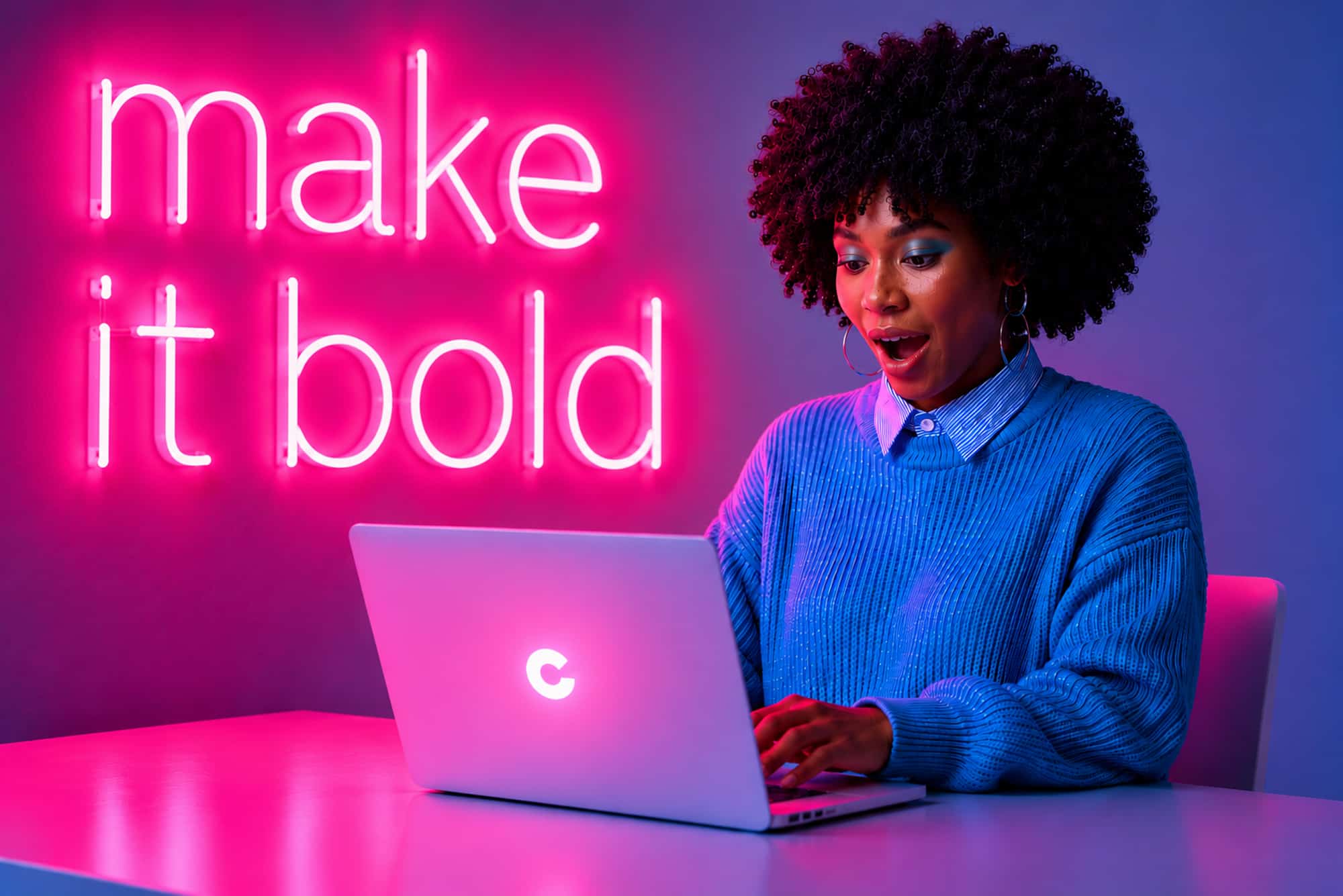
Dopamine Design: Why Bold, Bright Websites Are Winning

For the better part of a decade, the design world had a love affair with minimalism.

White space everywhere. Muted tones. Barely-there typography. The less you said visually, the more sophisticated you seemed. Clean was king. And for a while, it worked. Clean design felt modern. Trustworthy. Premium.

Then the internet got very, very clean, and suddenly all those minimal, sophisticated, white-spaced websites started to look exactly the same.

Enter dopamine design. And it’s changing what it means to have a brand that gets noticed.

What Is Dopamine Design?

The term comes from neuroscience — specifically the idea that certain visual stimuli trigger the brain’s reward system, producing a small but real hit of pleasure. Bright colors, high contrast, bold patterns, and playful elements. These choices go beyond aesthetic preference and actually produce a genuine physical response in the viewer.

In web design, dopamine design refers to a broad aesthetic trend toward visual boldness: saturated color palettes, vibrant gradients, high-contrast pairings, expressive typography, playful layouts, and design choices that feel joyful rather than restrained. It’s a direct reaction to the sea of beige minimalism that swept through every industry’s branding over the past ten years. Audiences are tired of everything looking the same. They want to feel something when they land on a website.

Why It’s Working

There’s a business case for this, not just an aesthetic one. Attention is the scarcest resource in digital marketing. The average time a visitor spends deciding whether to stay on your website is somewhere between three and eight seconds. In that window, your design is doing the persuading, not your copy. A bold, visually energetic site creates an immediate impression: “This brand has a personality. This brand has confidence. This is worth my time.”

High-contrast, saturated palettes also score well on accessibility metrics, which is increasingly important both ethically and legally as WCAG standards evolve. Good dopamine design isn’t just pretty — it’s readable, navigable, and designed for humans across the full spectrum of visual ability.

There’s also the social media effect to consider. Content that looks distinctive gets shared. A website with a bold, memorable visual identity produces screenshots, reposts, and “did you see this?” moments that a beige website simply doesn’t inspire. Your design is marketing. 

Getting It Right

Dopamine design done well is energetic without being chaotic. Here’s where brands tend to find the balance:

  • Start with color intentionality. Bold doesn’t mean random. The most effective dopamine-design palettes are deliberate: usually a hero color that’s vibrant and unexpected, paired with carefully chosen contrasts that guide the eye without overwhelming it. The goal is energy with clarity, not chaos.
  • Let typography do more work. Expressive type (oversized headlines, unexpected weights, dynamic sizing) is one of the most powerful tools in the dopamine design toolkit. When type has personality, the whole page comes alive without needing a single additional graphic element.
  • Use motion with purpose. Subtle animation, hover states, and scroll-driven interactions amplify the dopamine effect without slowing load times or frustrating users. The key word is subtle. Animation should enhance the experience, not perform for its own sake.
  • Maintain hierarchy. This is where bold design gets in trouble. A site that’s visually loud but poorly organized confuses users. Dopamine design should feel exciting and intuitive, not exciting and overwhelming. Visual boldness in the wrong places — particularly in the areas where users are trying to find information or take action — works against you.
  • Commit to the personality. Half-bold doesn’t work. A site that tries to be both minimal and maximalist ends up looking unresolved. If you’re going to embrace a bolder visual identity, go there. Own it. The brands that do this successfully are the ones that commit.

What This Means for Your Brand

If your website currently lives in the safe center of the design spectrum — clean, professional, and unoffensive — ask yourself an honest question: does it actually look like you? Does it communicate the energy, the personality, and the distinctiveness you want your clients to feel?

If the answer is no, that’s not a cosmetic problem. It’s a brand problem. Because for most of your prospects, your website is the first impression. And “safe and forgettable” is not the impression that wins the business.

Bold isn’t right for every brand. But more brands have the permission to be bolder than they realize. You have more canvas than you think. The question is whether you’re willing to use it.

Want a website that actually looks and feels like your brand? Let’s build something bright. Contact us at info@colouroutside.com

After SEO: What Is Answer Engine Optimization (And Why It Matters Now)

For the better part of two decades, the digital marketing playbook started with a straightforward question: how do we rank on Google?

That question isn’t going away. But it’s no longer enough on its own. Because increasingly, the place your audience is going to get answers isn’t a list of blue links — it’s a direct response from an AI, spoken back through a voice assistant, or surfaced at the top of a search results page before anyone clicks anything.

Welcome to the era of Answer Engine Optimization. And if you haven’t started thinking about it, now is the time.

What’s Actually Changing

Google’s own data shows a 70% year-over-year increase in searches starting with “tell me about…” and “how do I…” queries have hit all-time highs. The language people use when they search has shifted from keyword fragments (“branding agency Williamsburg”) toward full conversational questions (“what does a branding agency actually do for a small business?”).

This shift is being driven by two things happening simultaneously. First, AI tools have normalized conversational interaction. People are used to asking questions in natural language and getting direct answers. They’re bringing that behavior to search. Second, search engines — and AI assistants like ChatGPT, Perplexity, and Google’s Gemini — are delivering those answers directly, often without sending users to any website at all.

That’s the part that changes everything for content strategy.

SEO vs. AEO: What’s the Difference?

Traditional SEO is fundamentally about ranking — appearing on the first page of results so people click to your website. It optimizes for visibility in the list.

AEO — Answer Engine Optimization — is about being the answer. It optimizes for the content being cited, quoted, summarized, or surfaced directly by AI systems and search engines when a relevant question is asked.

The implications are significant. A site could rank on page one of Google and see traffic fall if AI is answering those queries before anyone clicks through. Conversely, a brand with genuinely authoritative, clearly-structured, question-answering content could find itself cited in AI responses to an audience they never would have reached through traditional ranking.

What AEO Requires

The good news: AEO doesn’t require a completely different content strategy. It requires a sharper version of a good content strategy. Here’s what that looks like:

  • Write for questions, not just keywords. Every piece of content you create should have a clear question it’s answering. Not implicitly — explicitly. Structure your content so the question is clear, the answer is direct, and the supporting detail comes after the core response. AI systems and featured snippets reward content that gets to the point.
  • Build genuine authority. AI systems are drawing from the most trusted, most cited, most comprehensive sources on a given topic. Generic content that covers the surface of a topic won’t make the cut. Go deeper. Cover the angles. Demonstrate real expertise. The more your content becomes a genuine reference on your topic area, the more likely it is to be surfaced as an answer.
  • Use structured, scannable formatting. Clear headers, concise paragraphs, Q&A formats where appropriate. Search engines and AI systems parse content that’s well-organized significantly more effectively than dense blocks of text.
  • Build your brand’s credibility signals. Reviews, testimonials, third-party mentions, press coverage, consistent publishing — these signals tell search engines and AI systems that you’re a legitimate authority. They’re not new, but they matter more now.
  • Think about voice search. When someone asks their phone “what is the best roofing company in [city]?” the answer they get is pulled from structured, authoritative content. Optimize your website’s content to answer the specific questions your best clients are asking out loud.

The Bigger Opportunity

Here’s what most brands are missing about AEO: it’s actually a brand-building opportunity, not just a traffic optimization tactic.

When an AI assistant cites your content, or your brand appears as the answer to a question someone asked in natural language, the impression it creates is entirely different from a paid ad or even an organic ranking. It creates the perception of authority. You’re not advertising — you’re being recommended by a trusted source.

That’s the kind of visibility that compounds. And it starts with having something genuinely worth saying, organized so it can actually be found and understood.

The brands that win the next generation of search won’t be the ones that gamed the algorithm best. They’ll be the ones that became the most useful, most authoritative voice on the topics their audience cares about.

Turns out, that’s just good marketing.

Want to make sure your content strategy is built for how people actually search today? Let’s colour.

Is Your Brand Actually Differentiated — Or Just Loud?

There’s a difference between being loud and being memorable. A lot of brands haven’t figured that out yet.

We live in the noisiest marketing environment in history. Every brand is posting, boosting, targeting, and optimizing. Every competitor has a website, a social presence, and a carefully crafted “About Us” page that says something about being “passionate” and “customer-focused.” And somehow, despite all that activity, most of them fade into exactly the same gray background they were trying to escape.

So here’s the uncomfortable question: Is your brand actually differentiated? Or are you just making more noise than the person next to you?

Differentiation Isn’t a Design Choice

Here’s where a lot of brands go wrong. They invest in a new logo, refresh the website, pick better fonts, and call it differentiation. Visuals matter — we’ll be the first to defend them. But if you strip away the design, is there still something underneath that no one else is saying? Something no one else is?

Real differentiation lives at the intersection of who you genuinely are and what your audience genuinely needs. It’s not manufactured. It’s excavated. You don’t invent it – you uncover it, sharpen it, and then relentlessly commit to it across every single touchpoint.

Marty Neumeier, one of the sharpest minds in branding, put it plainly: “A brand is a person’s gut feeling about a product, service, or organization.” You can’t control that feeling entirely. But you can earn it. And earning it starts with knowing, with real clarity, what makes you different – not just better.

The Sameness Trap

AI has made the sameness problem significantly worse. The internet is now saturated with content that sounds competent, professional, and completely interchangeable. Scroll through LinkedIn on any given morning and you’ll find fifteen posts that make the same three points about leadership, wrapped in the same slightly-too-optimistic tone.

That’s not marketing. That’s wallpaper.

When everything looks and sounds the same, differentiation is survival. Your audience is more sophisticated than ever. They’re tuning out anything that doesn’t feel specific, genuine, or earned. The brands breaking through right now aren’t the ones spending the most. They’re the ones who are clearest about who they are and most committed to expressing it.

Three Questions That Cut Through The Noise

If you’re not sure whether your brand is truly differentiated, start here:

  1. Can you finish this sentence without using the word “quality”?

“We’re different from our competitors because ___________.”

If your answer involves words like “quality,” “passion,” “dedicated,” or “innovative,” you’re not differentiated. You’re describing what every brand claims. Try again. Dig deeper. Get specific.

  1. Would your best customer recognize your brand in a blind test?

Pull your most recent social post, your latest email, a page from your website. Now strip off the logo and the name. Does it still sound unmistakably like you? Or could it belong to any of your competitors?

  1. What would your audience lose if you disappeared tomorrow?

This is the sharp one. If the honest answer is “not much, they’d just go elsewhere,” that’s not a brand problem — it’s a positioning problem. And positioning is fixable, but only if you’re willing to be honest about it first.

Differentiation Is a Decision, Not an Accident

Here’s the thing nobody tells you: real brand differentiation requires saying no. A lot. It means being bold enough to stand for something specific, even if that means not appealing to everyone. It means resisting the urge to chase every trend, copy what’s working for your competitor, or soften your edges so you don’t offend anyone.

The most memorable brands — the ones that build loyalty, command premium pricing, and generate word-of-mouth without a massive ad budget — all made a choice. They decided to own something. A point of view. A specific audience. A style. A standard. And then they held onto it, even when it was uncomfortable.

Disrupting the gray isn’t just a tagline. It’s a strategy. The gray is crowded. The gray is safe. The gray is forgettable. And if your brand is living there right now, no amount of ad spend is going to save it.

The good news? You have more canvas than you realize. You just have to be willing to colour outside the lines.

Ready to figure out what makes your brand genuinely different? Let’s talk: https://www.colouroutside.com/contact