

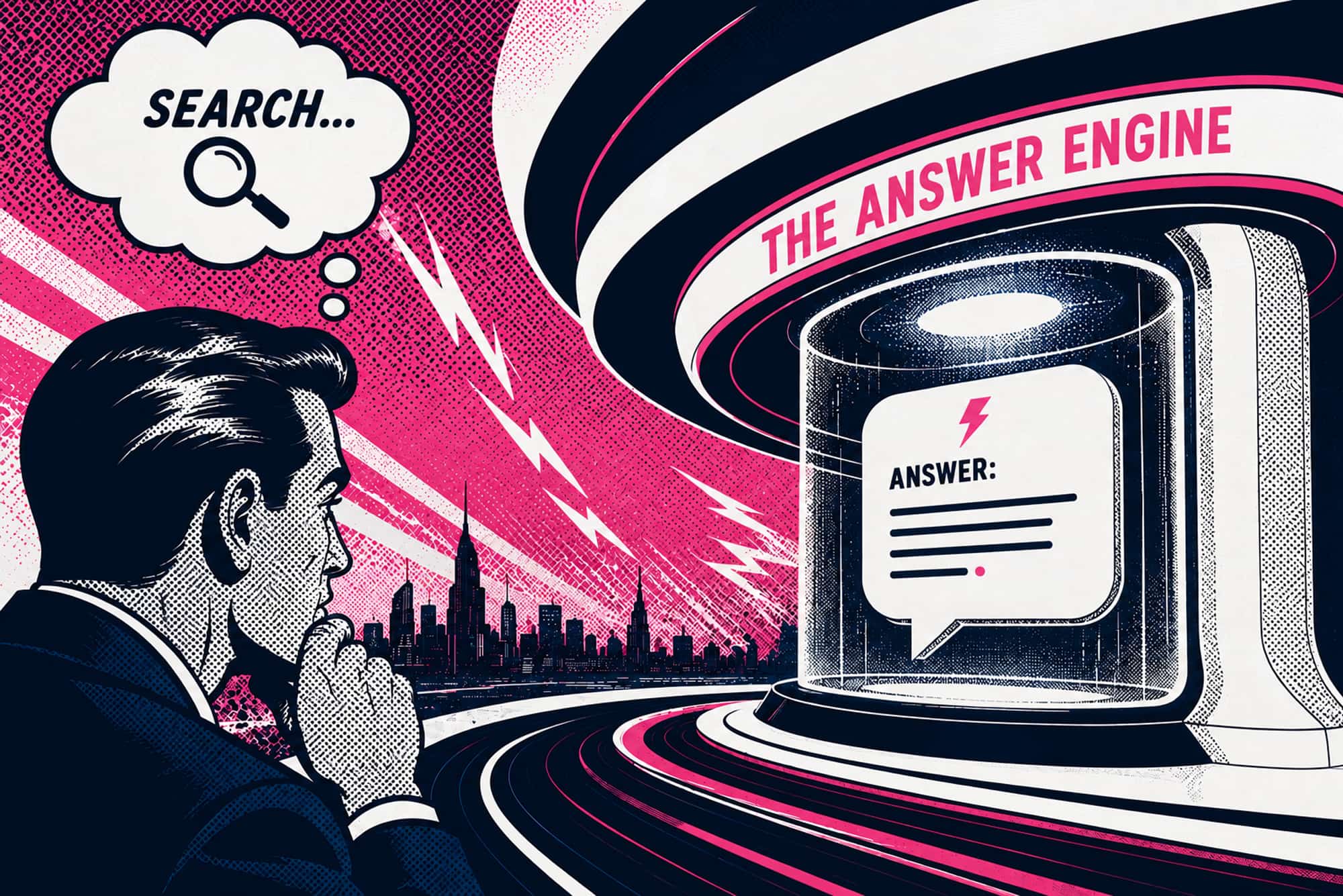
For the better part of two decades, the digital marketing playbook started with a straightforward question: how do we rank on Google?
That question isn’t going away. But it’s no longer enough on its own. Because increasingly, the place your audience is going to get answers isn’t a list of blue links — it’s a direct response from an AI, spoken back through a voice assistant, or surfaced at the top of a search results page before anyone clicks anything.
Welcome to the era of Answer Engine Optimization. And if you haven’t started thinking about it, now is the time.
What’s Actually Changing
Google’s own data shows a 70% year-over-year increase in searches starting with “tell me about…” and “how do I…” queries have hit all-time highs. The language people use when they search has shifted from keyword fragments (“branding agency Williamsburg”) toward full conversational questions (“what does a branding agency actually do for a small business?”).
This shift is being driven by two things happening simultaneously. First, AI tools have normalized conversational interaction. People are used to asking questions in natural language and getting direct answers. They’re bringing that behavior to search. Second, search engines — and AI assistants like ChatGPT, Perplexity, and Google’s Gemini — are delivering those answers directly, often without sending users to any website at all.
That’s the part that changes everything for content strategy.
SEO vs. AEO: What’s the Difference?
Traditional SEO is fundamentally about ranking — appearing on the first page of results so people click to your website. It optimizes for visibility in the list.
AEO — Answer Engine Optimization — is about being the answer. It optimizes for the content being cited, quoted, summarized, or surfaced directly by AI systems and search engines when a relevant question is asked.
The implications are significant. A site could rank on page one of Google and see traffic fall if AI is answering those queries before anyone clicks through. Conversely, a brand with genuinely authoritative, clearly-structured, question-answering content could find itself cited in AI responses to an audience they never would have reached through traditional ranking.
What AEO Requires
The good news: AEO doesn’t require a completely different content strategy. It requires a sharper version of a good content strategy. Here’s what that looks like:
- Write for questions, not just keywords. Every piece of content you create should have a clear question it’s answering. Not implicitly — explicitly. Structure your content so the question is clear, the answer is direct, and the supporting detail comes after the core response. AI systems and featured snippets reward content that gets to the point.
- Build genuine authority. AI systems are drawing from the most trusted, most cited, most comprehensive sources on a given topic. Generic content that covers the surface of a topic won’t make the cut. Go deeper. Cover the angles. Demonstrate real expertise. The more your content becomes a genuine reference on your topic area, the more likely it is to be surfaced as an answer.
- Use structured, scannable formatting. Clear headers, concise paragraphs, Q&A formats where appropriate. Search engines and AI systems parse content that’s well-organized significantly more effectively than dense blocks of text.
- Build your brand’s credibility signals. Reviews, testimonials, third-party mentions, press coverage, consistent publishing — these signals tell search engines and AI systems that you’re a legitimate authority. They’re not new, but they matter more now.
- Think about voice search. When someone asks their phone “what is the best roofing company in [city]?” the answer they get is pulled from structured, authoritative content. Optimize your website’s content to answer the specific questions your best clients are asking out loud.
The Bigger Opportunity
Here’s what most brands are missing about AEO: it’s actually a brand-building opportunity, not just a traffic optimization tactic.
When an AI assistant cites your content, or your brand appears as the answer to a question someone asked in natural language, the impression it creates is entirely different from a paid ad or even an organic ranking. It creates the perception of authority. You’re not advertising — you’re being recommended by a trusted source.
That’s the kind of visibility that compounds. And it starts with having something genuinely worth saying, organized so it can actually be found and understood.
The brands that win the next generation of search won’t be the ones that gamed the algorithm best. They’ll be the ones that became the most useful, most authoritative voice on the topics their audience cares about.
Turns out, that’s just good marketing.
—
Want to make sure your content strategy is built for how people actually search today? Let’s colour.